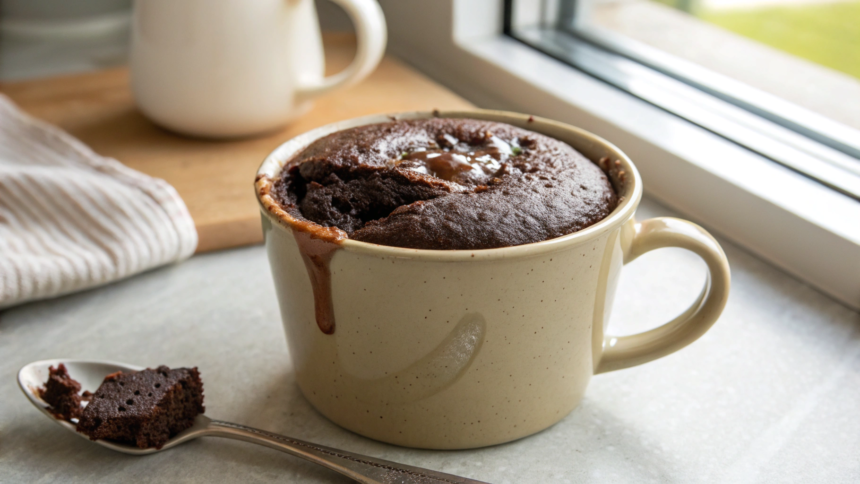
Moist chocolate mug cake comes in single-serve dessert forms, and the final texture is determined by how long it takes to make, how many ingredients are used, and how hot the microwave is. In this situation, cocoa powder, flour, and liquid ratios interact during short cooking cycles to make moist chocolate mug cake.
- Table of Contents
- Eggless chocolate mug cake in microwave recipe step by step
- How long to cook chocolate mug cake in microwave for perfect texture
- Best microwave time and power level for mug cake without egg
- How to store leftover chocolate mug cake and keep it moist
- Can you refrigerate mug cake and reheat it later?
- Tips to make soft and moist chocolate mug cake without eggs
- Why did my chocolate mug cake turn rubbery in microwave
- How to fix dry or overcooked mug cake at home
- Conclusion
Table of Contents
There are still a lot of eggless cake recipes out there, especially for microwave cakes that use chemical leavening instead of structure from eggs.
Eggless chocolate mug cake in microwave recipe step by step
Moist chocolate mug cake forms in a confined microwave cycle where ingredient ratio and fixed heating duration control structure. In eggless cake systems, there is no protein network from eggs, so the batter depends on flour hydration, oil distribution, and rapid steam expansion. The mixture sets quickly once internal temperature crosses the starch gelatinization range, which occurs within seconds under microwave exposure.
| Step | Action | Exact Input |
| 1 | Dry mix | 4 tbsp all-purpose flour + 2 tbsp cocoa powder + 3 tbsp sugar + ¼ tsp baking powder + pinch salt |
| 2 | Liquid addition | 3 tbsp milk + 2 tbsp oil + ¼ tsp vanilla |
| 3 | Mixing | 40–50 sec until smooth, no visible dry pockets |
| 4 | Mug selection | 250–300 ml mug, inner diameter 7–8 cm |
| 5 | Fill level | The batter should occupy 50–60% volume only |
| 6 | Microwave | 800W for 80 seconds (single continuous cycle) |
| 7 | Rest phase | 120 seconds, internal heat completes setting |
At this scale, moist chocolate mug cake sets from inside outward. No crust formation occurs. Structure remains dependent on retained steam.
How long to cook chocolate mug cake in microwave for perfect texture
Moist chocolate mug cake operates within a narrow time band where moisture retention and structure formation overlap. Outside this band, texture shifts quickly from under-set to dry.
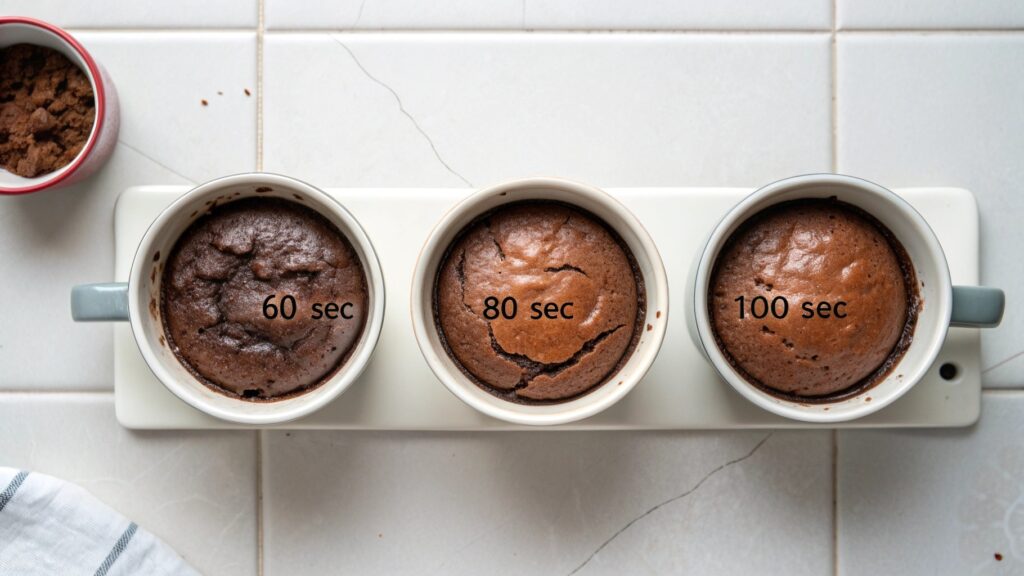
- 80W → 75–85 seconds produces balanced crumb with soft center
- 900–1000W → 60–70 seconds produces faster set, slightly tighter edges
- 700W → 90–100 seconds produces softer structure but uneven core risk
- Beyond 95 seconds at 800W → moisture loss becomes visible
- Below 60 seconds → batter remains semi-liquid at center
Microwave heating continues briefly after shutdown. Carryover heat completes internal setting.
Best microwave time and power level for mug cake without egg
Moist chocolate mug cake depends on wattage as the primary control variable. Microwave systems do not maintain a stable Celsius temperature. Instead, energy output defines how quickly internal water converts to steam and sets the batter.
| Wattage | Time | Internal Condition |
| 1000W | 65 sec | Rapid expansion, firmer outer zone |
| 900W | 70 sec | Even set, slight edge firmness |
| 800W | 80 sec | Stable soft structure across volume |
| 700W | 95 sec | Slower set, possible uneven moisture |
| 600W | 115–125 sec | Weak structure, patchy cooking zones |
Approximate internal temperature during set phase ranges between 90°C and 100°C, where water activity drives expansion and starch sets.
How to store leftover chocolate mug cake and keep it moist
Moist chocolate mug cake loses water rapidly after cooling due to exposed surface area. Moisture migration begins within minutes and continues until equilibrium with surrounding air is reached.
- Open exposure → surface dries within 2–3 hours at 25°C
- Covered at room temperature → retains softness for 8–12 hours
- Airtight container → slows evaporation rate but does not stop it
- Refrigeration at 4–6°C → extends storage to 24 hours, increases firmness
- Reheating at 700W for 15–20 seconds shifts moisture back toward center
Eggless cake shows faster firmness due to lower binding structure.
Can you refrigerate mug cake and reheat it later?
Moist chocolate mug cake remains stable under refrigeration at 4–6°C, though internal structure becomes compact as fats solidify and moisture redistributes. Within 6–8 hours, crumb density increases. Reheating at 700–800W for 20–25 seconds softens the outer and mid layers. The original softness does not fully return because evaporated moisture during the first heating cycle is not recoverable.
Tips to make soft and moist chocolate mug cake without eggs
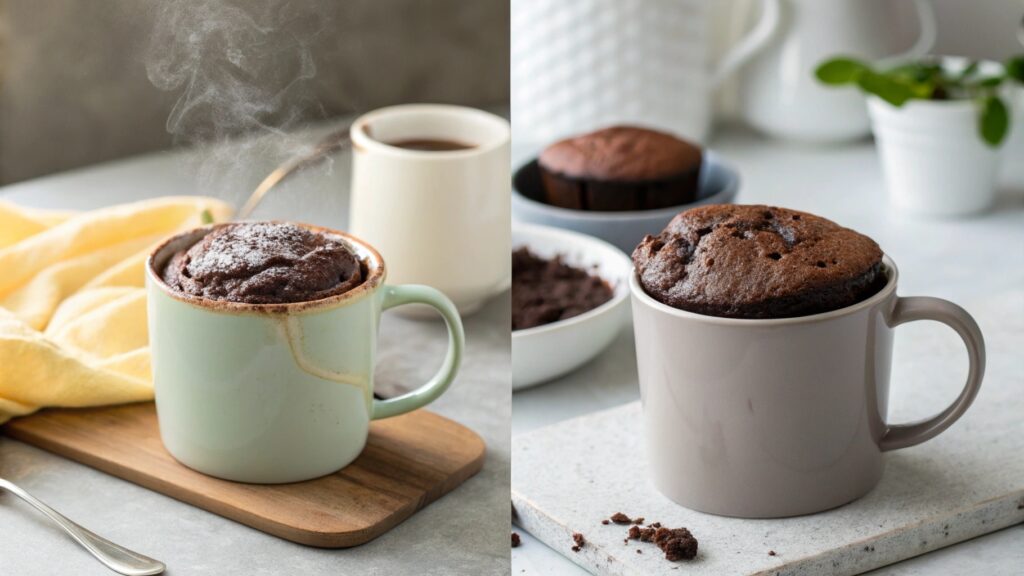
Moist chocolate mug cake responds directly to ratio precision and fixed microwave exposure. Variation beyond small limits produces visible structural differences.
- Maintain dry to liquid ratio close to 1:1.4–1.5
- Limit mixing to under 50 seconds to avoid tightening batter
- Keep microwave setting near 800W baseline
- Use mug diameter between 7–8 cm for even heat spread
- Add 1 tbsp chocolate chips to create localized moisture zones
- Avoid overfilling beyond 60% to prevent collapse after rise
Texture remains a result of moisture retention during the short heating phase.
Why did my chocolate mug cake turn rubbery in microwave
Moist chocolate mug cake becomes rubbery when internal water is driven out beyond the retention point. At 800W, exposure beyond 90–100 seconds causes starch tightening and collapse of steam pockets. Overmixing increases this effect by creating a denser batter before heating. The resulting texture reflects compression under heat rather than imbalance in ingredients.
How to fix dry or overcooked mug cake at home
Moist chocolate mug cake that dries out has already lost internal water content. Adjustment focuses on partial moisture reintroduction.
Add 1–2 teaspoons milk directly over the surface. Cover the mug.Microwave at 600–700W for 15–20 seconds.
Steam generated during reheating moves inward and softens outer layers.
Core density remains largely unchanged.
Conclusion
Moist chocolate mug cake operates within a short microwave cycle where cocoa powder, flour, and liquid ratios interact directly with wattage and time. Moist chocolate mug cake remains stable when held near 800W and under 90 seconds, where internal moisture supports structure. Eggless cake and microwave cake formats show similar behavior, with rapid setting and equally rapid moisture loss.
Across these conditions, results vary through small shifts in timing, storage temperature, and reheating patterns rather than large process changes.